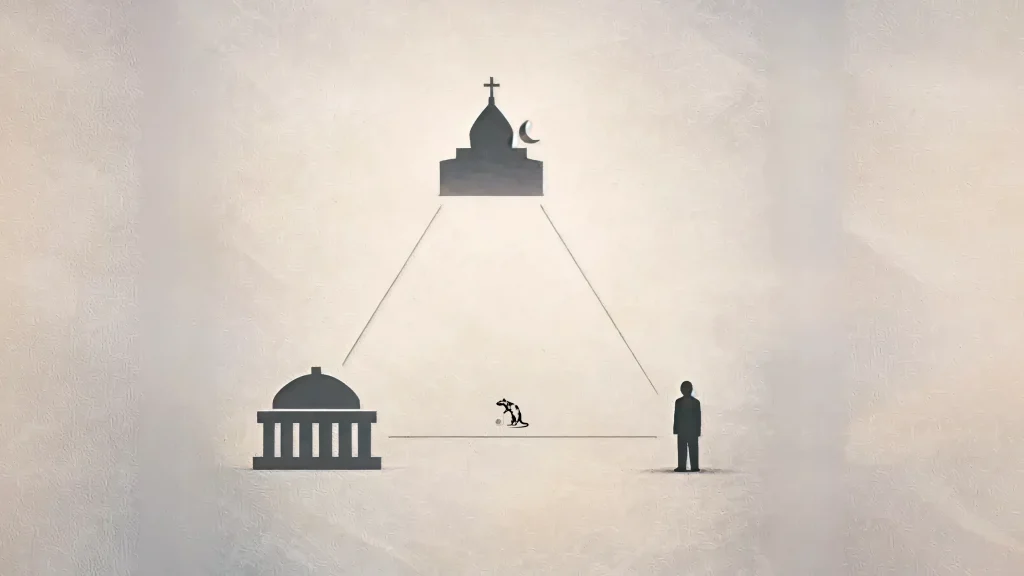


You have probably cried for a dog. Perhaps not yours; perhaps a stray seen limping across a road, or a scene in a film where a golden retriever breathes its last. Your throat tightened. Your eyes filled with tears. You felt the specific, aching sting of loss as if something had been personally taken from you. You, a creature of complex thought and moral aspiration, were moved to genuine grief by the dying of an animal that cannot even comprehend its own death.
And somewhere else on this same spinning planet, at that very moment, men in uniforms, or men in boardrooms, or men in parliaments, men who also cry at dogs, mind you, were signing orders, approving campaigns, sanctioning policies that would end the lives of hundreds. Thousands. And they slept perfectly well that night. Some of them had dinner parties
Now, before you rush to call those men monsters, and thereby spare yourself the uncomfortable investigation: pause. Because the question is not about monsters. Monsters would be convenient. The question is about you. It is about us. It is about what we actually are beneath the monument of civilization we have erected to convince ourselves we are something grander.
Josef Stalin, a man with some experience in the matter of mass death, is attributed with the observation that one death is a tragedy, while a million deaths is a statistic. He was not being poetic. He was being precise.
Psychologists call this the Identified Victim Effect. When we are shown a single face, a child, a dog, a name with a photograph, our empathy ignites like a match struck in a dark room. When we are shown a number, ten thousand, a hundred thousand, six million, our empathy sits quietly in its chair and does nothing in particular. The mind, it turns out, did not evolve to feel six million of anything. It evolved to feel the person standing in front of it.
The dog has a name. The dog has eyes that looked at you. The dog existed at a scale your nervous system was designed to comprehend. The massacre exists only as an abstraction, and the human brain, for all its miraculous complexity, is shockingly bad at abstractions that involve suffering.
This is not a moral failure. Or rather, it is moral failure; it is first, and more fundamentally, a biological design. Your empathy is an instrument of near range. It was built for the tribe, the village, the face across the fire. It was never engineered for the global scale. The problem is that you now live at a global scale while still operating on tribal software. You are, in the most technical sense, running an ancient programme on a machine far too large for it.
Let us dispense with the flattering story first. The flattering story goes: humans are naturally compassionate, and war and violence are aberrations, corruptions imposed by power, poverty, or ideology. Rousseau believed something like this. He imagined a Noble Savage, pure and gentle, ruined by the machinery of civilization. It is a beautiful theory. It is also, largely, wrong.
Biology tells a less romantic story. For roughly 99% of human existence, we lived in small bands of thirty to one hundred and fifty people. Within those bands, cooperation was essential and extraordinary: we shared food, raised each other’s children, mourned each other’s dead. Human beings are genuinely, measurably, the most cooperative large animal on Earth. Our capacity for empathy, for love, for sacrifice is real, and it is vast.
But here is the part that gets left out of the inspirational posters: those same bands were in constant, often violent competition with other bands. The very neurological systems that made us deeply loving toward our in-group made us capable of profound indifference, or active aggression, toward the out-group. Empathy, from the beginning, was not a universal solvent. It was a tribal glue.
The dog that lives in your house has been admitted, neurologically speaking, into your tribe. It has a name. It has rituals with you: the morning walk, the evening bowl. Your brain has filed it, without your conscious consent, under us. The stranger dying in a country you cannot find on a map has been filed, by the same merciless bureaucracy of the brain, under them. And the brain, ancient and unsentimental, treats those categories very differently.
But biology only begins the explanation. Humans are also, and this is the crowning, terrible achievement of our intelligence, remarkably skilled at constructing social systems that do the work of moral disengagement for them. We do not simply fail to feel for distant strangers. We build elaborate machinery to ensure we do not have to.
The sociologist Zygmunt Bauman, writing in the shadow of the Holocaust, identified the central mechanism: bureaucratic distance. When you kill a man with your hands, you must look at his face. When you sign a form that redirects resources that would have saved a thousand people, you are at lunch. The longer the chain of command, the more diffuse the responsibility, the more invisible the consequence, the more comfortably ordinary people participate in extraordinary harm. Adolf Eichmann, who coordinated the transportation of millions to their deaths, was described by Hannah Arendt not as a demon but as a bureaucrat. A man of meticulous paperwork and no particular hatred. He was, she wrote, appallingly, disturbingly normal.
Evil, in its most industrial form, does not require evil men. It requires ordinary men, a system sufficiently complex that no single person feels responsible, and enough distance between the decision and the body.
Hannah Arendt: The Banality of Evil
Euphemism is part of this machinery. You do not kill civilians. You produce collateral damage. You do not starve a population. You implement sanctions. You do not massacre villages. You conduct pacification operations. Language, that highest of human gifts, has been ingeniously repurposed as an anaesthetic. Every atrocity in recorded history has been accompanied by a vocabulary designed to ensure that those who commit it need never quite confront what they are doing.
And here we arrive at the deepest irony of all. Because the human animal is not only capable of violence: it is also the only animal that has ever built hospitals for strangers, written declarations of universal rights, developed philosophies of non-violence, and wept genuinely for beings it has never met. The same species that invented the concentration camp also invented the Red Cross. The same civilization that committed the transatlantic slave trade also produced the abolitionists who dismantled it.
We are the only creature that argues with itself about what it owes to all other creatures. No lion convenes a tribunal to debate whether hunting was just. No chimpanzee writes manifestos about cross tribal solidarity. Only humans have looked at their own tribal instincts and said: these are insufficient. We can do better than what nature made us. This is not nothing. This is, in fact, extraordinary.
But notice the escape hatch this creates. The existence of idealism has become, for many humans, a substitute for action rather than a spur to it. We feel moved by the story of a refugee child. We post it. We feel. The feeling itself has become the moral act. The philosopher Peter Singer calls this the most comfortable illusion of the modern age: the belief that awareness is the same as responsibility. That to know of suffering, to feel bad about it, to speak against it, constitutes a meaningful response. Meanwhile, the suffering continues at industrial scale, and we return to our evening.
You are a saint who weeps beautifully and changes very little. And the genius of the system around you is that it was designed precisely to produce that outcome, not through conspiracy, but through the accumulated logic of a world that prefers your consumption to your conscience.
There is a reason this question makes us uncomfortable in a way that other philosophical questions do not. The question of whether free will exists is distressing but abstract. The question of whether God is real is vertiginous but impersonal. But the question of why we cry for dogs and not for massacres: this one is about you specifically, right now, and what you did this week.
Because the honest answer is not that you are different from the soldiers who carried out atrocities. The honest answer, backed by Stanley Milgram’s infamous obedience experiments, by Philip Zimbardo’s Stanford Prison Study, by a century of social psychology, is that under the right conditions of authority, anonymity, and gradual escalation, the majority of ordinary, kind, dog loving people will participate in the harm of other people. Not the sociopaths. Not the outliers. The majority. You.
Milgram asked ordinary American citizens to administer what they believed were increasingly dangerous electric shocks to a stranger at the instruction of an authority figure. Sixty-five percent of them went all the way to the maximum. They were, by all external accounts, decent people. They showed distress. Some wept. And they continued anyway. Because authority was present, because the chain of responsibility was distributed, because there was just enough distance between the lever and the scream.
The banality of evil is not that evil men do evil things. It is that good men, moral, feeling, dog loving men, do evil things when the architecture around them makes it easy enough and distant enough and named carefully enough.
The soldiers who carried out the Rwandan genocide in 1994 were, before April of that year, farmers, teachers, neighbours. Some had been friends with the people they killed. In the space of a hundred days, under the intoxication of tribal propaganda, ordinary human beings murdered approximately eight hundred thousand of their countrymen with machetes. With their hands. Up close. People they recognized. And many of them, before and after, were people who would have wept for a child or a cow. This is the fact we keep looking away from: the distance between a person who weeps for a dog and a person who kills without flinching is not the distance between two different kinds of people. It is the distance between two different sets of conditions.
So what are we to do with this? We cannot reverse the evolution of our tribal brain. We cannot feel six million of anything. We cannot dismantle all the systems that diffuse moral responsibility across ten thousand signatories. We are the animal we are.
But we are also, and this is the clause that changes everything, the animal that knows what it is. And that knowledge, uncomfortable as it sits, is not nothing. It is, in fact, the only lever we have ever had.
The moral circle of human concern has, if we are honest about history, been expanding. Slowly. With enormous backslidings. With rivers of blood separating each increment. But expanding nonetheless. Once, only your family mattered. Then your tribe. Then your city. Then your nation. Now, haltingly, imperfectly, with great hypocrisy and inconsistency, we argue about the rights of strangers on other continents and the wellbeing of animals and the welfare of future generations who have not yet been born. This expansion did not happen by instinct. It happened by argument. By literature. By people who looked at the comfortable edge of their own moral circle and deliberately, effortfully pushed it outward. It happens every time a human being looks at a statistic and forces themselves to imagine the face behind it.
The resolution, then, is not that you are good. It is not that you are saved by your tears for the dog. The resolution is that you are capable of knowing your own architecture, and that knowledge, applied with honesty, is the only thing that has ever changed anything. Not sentiment. Not guilt. Knowledge, and the friction of choosing, again and again, to extend the range of what you allow yourself to feel.
You are not a saint with occasional lapses. You are not a monster with a thin coat of civility. You are a brilliantly wired primate whose empathy was built for a village and whose violence was honed for a rival tribe, now standing bewildered in a civilization of eight billion, trying to make sense of what you owe to people you will never see.
You are an animal that builds cathedrals and gas chambers, that writes love poetry and drops cluster bombs, that weeps for a dog and signs the form, that is capable of almost infinite tenderness toward what is near and almost infinite indifference toward what is far.
And you are, this is the part that cannot be borrowed from any other species, the animal that looks at all of this and asks why. That holds the question. That refuses, if it is honest, to be comforted by easy answers about human goodness or human evil.
You are not as saintly as you think. But you are not as helpless as despair would have you believe. The dog’s name was Max. You remember it still. Now try, just try, to remember one name from the statistic you scrolled past last Tuesday. Just one. See what happens to the number when it becomes a name. See what happens to you.
That is where the work begins. Not in grand philosophy or political revolution. In the deliberate, uncomfortable, daily practice of refusing to let your empathy stop at the edge of what is convenient.
Everything else is just the sound of a species talking to itself about how civilized it is.