

Within the vicinity of Taxali Gate lies Heeramandi, a neighborhood comprising bazaars, a market selling musical instruments, houses/brothels, and shrines. It has undergone significant transformations over time and is now in abject condition. It is a striking contrast to its nearby vibrant food street.
The colonial era modified the character of Heeramandi. The British military presence transformed the district into a space of transactional pleasure and prostitution, contrary to its literary and artistic character before, catering to the sexual needs of the British soldiers.
My first encounter with this space was not in Muharram but through a cultural tour organized by a group that explored heritage spaces in Lahore. Walking through the narrow, twisting arteries of the Taxali Gate in old Lahore just as the sun begins to set. You will feel the weight of two very different worlds colliding.
On one hand, there is the ghost of the diamond market, the Heeramandi, a place that the state and the self-righteous society have spent decades trying to erase, scrub clean, or hide behind a curtain of “morality.” On the other hand, there is the heavy scent of incense and the sound of the marthiya, the lament for the fallen at Karbala, during the months of mourning and beyond.
Our first stop was an Imambargah situated in an enclosed space primarily for women. A narrow passage opened into a courtyard adjacent to an Imambargah known as Kali Bari. This space was founded on a religious site that functioned as the temple of Kali.
The temple was abandoned by Hindus when they migrated at the time of Partition in 1947. A well-known tawaif in the area, Mai Haajun. The local inhabitants told us that in the days of Muharram, Kali Bari offers a safe, enclosed space for women to perform Muharram rituals.
It was intriguing to me as I had experienced women’s Muharram rituals inside Imambargahs, but had never seen a place where the surroundings of an Imambargah were covered from the sight of people passing by. Not surprisingly, the word ‘bari’ in the local dialect also means an enclosed space and reveals its function.
Coming out of that space were loud and visible expressions of Shia identity in every nook and corner of Heeramandi. It was as if someone was trying to loudly proclaim their identity to the outside world and seeking some sort of validation from it. From the walls of local tandoors to the walls of the neighborhoods, from Zuljanah’s shed (horse taken out on Ashura) to small chambers with lamps and Alams (flags) outside homes, markers of faith are everywhere.
From posters to stalls, and even the engravings at the entrance of the Community Park near Taj Sweets, it seemed that the memory of Karbala was not just invoked in Muharram, but it was a part and parcel of daily life, something that needed to be seen and shown.
For marginalized communities of this area, particularly women, these symbols serve as an everyday reminder to carry on with their lives and view themselves through this lens of this narrative of resistance, not with the one crafted by the state and society for them.
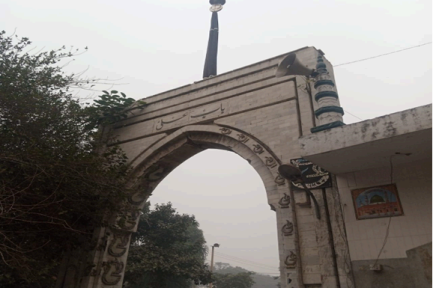
Entrance of Community Park in Shahi Muhalla with engravings of Ali’s name and the Flag of Abbas
The tour left me intrigued, and I decided to visit the space next time on my own. The fear and myths about the area and its people were already shattered for me. I visited Mai Eidan’s Imambargah, located at the back of the Andaaz restaurant.
The Imambargah was established in 1950. Mai Eidan was a tawaif of the area who made a Will to convert her home/brothel into an Imambargah. After her death, the women of the community honored her request and converted the house into a sacred space. This utterly transformed the meaning of the space; from a house of notoriety, it came to be known as a space of sanctity.
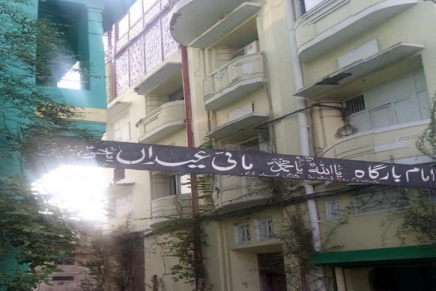
A signboard at the entry of the street leading to Mai Eidan’s Imambargah, beside Andaz Restaurant
Her gravestone in the vicinity of the Imambargah does not mention her father’s name; instead, her mother’s name is inscribed. This act in itself defies and challenges social norms; it can be said that even in death, Mai Eidan remained controversial. This is not something one can experience or witness in regular Shia spaces.
For instance, a man born out of wedlock cannot lead prayer in Shia jurisprudence, let alone become a founder of an Imambargah. Even so, a woman proudly flaunting herself with her mother’s name and with no shame attached to being born of ‘illegitimate birth’ in the words of the outside world, including their coreligionists.
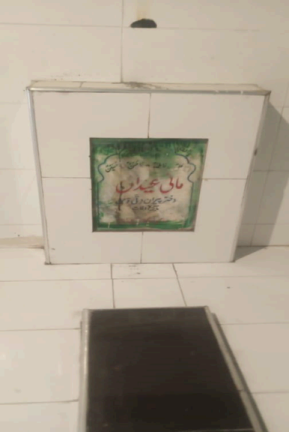
Grave of Mai Eidan inside Imambargah
For the women who live here, these two worlds aren’t just neighbors; they are survival. We have a habit in Pakistan of putting people in boxes. We like our holy or pious ones in the mosques and our sinners behind closed doors. But in the heart of Lahore’s most stigmatized district, those lines don’t just blur, but vanish.
They were declared “untouchables” by the colonial authorities. They put the community to the ranks of beggars, prostitutes, and thieves with newly formed legal frameworks. Both the Indian
Penal Code of 1860 and the Contagious Diseases Act of 1864 classified tawaifs as prostitutes. They involved Hindu and Muslim clergy to make marriage mandatory for all women.
The tawaif, a figure the law calls a “prostitute”, who historically enjoyed the role of prestige and honor, has found a way to do something the rest of us are too scared to try: she has claimed God for herself, even when the world told her she wasn’t allowed.
The Carceral Gaze
To understand why women in Heeramandi build sacred spaces in their houses, you first have to understand the cage she lives in. It isn’t just a cage of iron bars; it’s what we might call a “carceral world.” From the moment a girl is born in these streets, she is watched. Not with care, but with a clinical, judging eye.
The state watches her through the police who patrol the corners. Society watches her through the documentaries that treat her like a museum exhibit of “dying culture.” Even her own birth certificate is a weapon; without a father’s name, she is often denied the basic dignity of an identity card or a school seat. She is a person who exists physically but is legally a ghost.
The power is exercised by the unseen gaze of a watchman to regulate the behavior of those being watched. The community has to put up with police surveillance, especially after certain bans and legal limits had been set by the government for music performances and the rest of their activities.
Despite the absence of the watchman’s physical body and presence looming around, the mere idea and perception of being watched creates a psychological effect, resulting in self-policing within their own space.
This is reflected through the statement provided by one of the local pimps, Mehmud, who argues that their mobility is limited because they feel like they are ‘prisoners in that area’ due to the constant surveillance.
The Sacred Subversion
When every eye on the street is looking at you to find a reason to condemn you, you look for a space where that gaze can’t reach. For the women of Heeramandi, that space is the Imambargah. Wherever there is oppression, there is resistance. Almost every house in Heeramandi contains one.
However, every marginalized community needs some form of agency to assert itself and call out its oppressors’ actions. Karbala’s narrative and its constant remembrance shape the sense of identity and offer agency to resist oppressive structures.
The state would always involve religion to stigmatize these women. Due to the stigma in Pakistan attached to the profession of music and dance being “against the religion of Islam”, “Kanjar” word dramatically changed its connotation and transformed into a curse word from a community name for musicians and performers, meaning a person being of low morale or character.
Stigmatization, societal hatred, and misuse of religious narratives to defame courtesans initiated by the British grew after the formation of an Islamic Republic in 1947. Shiism and its tenets emerged as a form of protest that suited the needs of this community.
There is a profound irony in the fact that in a neighborhood the “pious” refuse to walk through, some of the most intense religious devotion in the city takes place. About 85% of the community identifies with the Shia faith, and this isn’t a coincidence. The history of the tawaif is tied to the old courts of Awadh, where the arts and the mourning of Muharram were deeply intertwined.
The connection between Shiism and Tawaifs is deeply rooted in Awadh’s Shia patronage as well. Since many Kanjars who migrated to Lahore were originally from North India, the influx of Shia ideology was inevitable in Lahore’s Heeramandi.
Not only that, Lucknow’s Imambargahs were offering patronage to tawaifs; they were also given an important role in Noha and Marsiya khuani in Lucknow. Something that could be seen in post-independence Lahore, where many notable marsiya reciters emerged from Heeramandi.
Awadh’s Tawaifs being predominantly Shia, and the immigration of the Kanjar community from Northern India to Heeramandi added to the strengthening of Shia practices in the area. The
relationship between Azadari rituals and the Tawaif community kept getting prominence in Lahore’s Heeramandi post-independence, which resulted in the construction of many female-led religious spaces.
But today, it’s more than just tradition. It’s resistance. When a woman who has been told she is “impure” her whole life stands up and organizes a religious gathering, she is committing a radical act. She is saying, “You do not own the sacred. You do not get to decide who is worthy of the divine.”
They have built their own spaces, places like Mai Eidan’s Imambargah or Kali Bari. These aren’t grand, gold-domed structures funded by the elite. They are often converted rooms in the same buildings where they live and work. By day, the world might see a “red-light district,” but during the days of Muharram, the space undergoes a spiritual alchemy.
The perfume of the bazaar is replaced by the smell of rose water. The music of the tabla is silenced for the sound of the matam. In these moments, the women aren’t “stigmatized bodies.” They are mourners. They are devotees. They are human.
Finding Power through Zaynab
The reason the story of Karbala resonates so deeply in these streets is that it is a story of the marginalized standing up to a tyrant. Specifically, these women look to Sayeda Zaynab, the granddaughter of the Prophet, who stood in the court of the tyrant Yazid and spoke truth to power when everyone else was silent.
For a woman in Heeramandi, Zaynab is the ultimate archetype. Zaynab was a woman who saw her family slaughtered, was marched through the streets as a prisoner, and was looked down upon by the “authorities” of her time. Yet, she never lost her agency. She took her grief and turned it into a weapon of words.
When the women of the area perform the rituals of mourning, they aren’t just crying for a historical tragedy. They are crying for their own children who can’t get into schools or are not accepted by society. They are crying for their sisters who are harassed by the police and abandoned by their lovers. They are crying because, even the likes of Zaynab have been cast as
the “other,” yet they know their own truth. Their mourning is a way of saying: I suffer, therefore I am.
As Italian priest and professor Christopher Clohssey beautifully described the scene of Zaynab’s encounter with Yazid in the court.
Among the captives, Yazid noticed a woman, encircled by other women, whose very demeanor signified defiance. Yazid lashed out, asking Who is this arrogant woman?’’ A surreal silence enveloped the court. The defiant woman rose to respond to this question and made her way through the women who surrounded her. Finally, face to face with Yazid, she retorted. ‘’Why are you asking the women? Ask me. I’ll tell you who I am. I am Muhammad’s granddaughter. I am Fatima’s daughter. Ask me, Yazid. The entire court was awestruck by the introduction of Zaynab.
It is worthy to be noted here that Zaynab introduced herself in the court of the ruler by the name of her mother, emphasizing the legacy of female resistance running in the family and matrilineal identity, where the entire bloodline was to be recognized through the name of a mother. Also, she was not the first one facing the ruler of her time face to face; her mother set the precedent before.
Certain elements can be learned and connected with the plight of women in Heeramandi. There is a template of resistance in Zaynab’s resistance and defiance of power, telling persecuted women of this community how they can also reclaim their voice in a society where somebody in their position is supposed to be silent or voiceless.
Because Zaynab didn’t let Yazid or anyone speak on her behalf or define her identity, they learnt how not to reduce themselves to the identity given to them by society.
The very space deemed as a red light area and notorious to visit for respectable families becomes sacred during Muharram through this association. As per Mai Eidaan’s family, she remained one of the wealthiest tawaifs of her era with numerous properties in her name. She dedicated a space for Azadari.
The first proper Imambargah in Heeramandi paved the way for other women-led Imambargahs in the area, where, as founders and organizers of religious rituals, they assert their identity in the face of social erasure. Not only did she initiate the first women-led procession too, much to the
distaste of ‘respectable’ Shia neighborhoods in the walled city. One can only find parallels in the story of influential Mahlaqa Bai, buried in Hyderabad, India, known for her patronage of Azadari.
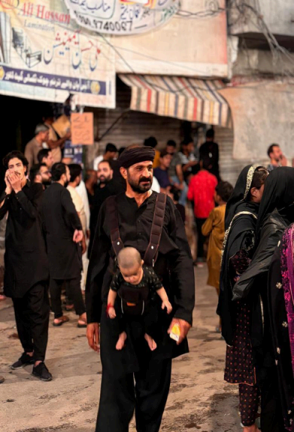
A man mourning along with his infant daughter during Muharram in Heeramandi
If Zaynab openly challenged the oppressive ruler, they too can do it quietly, their participation in Muharram and being custodians and founders of Azadari in their area, hosting the people from other parts of the city, who keep on detesting them throughout the year. It is in itself an act of defiance and a challenge to societal judgment and a refusal to give them a position of respect. They crafted it for themselves; others will not decide it for them.
It’s not only that they find agency and draw strength from the archetypes of Karbala in their day-to-day struggles, but also on socio-political levels. People of Heeramandi vividly remember the details of the 1963 riots on the day of Ashura in the Walled City and how people of their community were at the forefront.
One of the caretakers of Kali Bari Imambargah shares how he heard from his grandmother that women of Heeramandi went along with men that day and put themselves forward to Zuljanah (horse of Imam Hussain) when bricks were raining. He added that these women with no father figure around, consider Hussain as their father and view themselves as daughters mourning the suffering of their father.
Asking Alia, a tawaif in her forties, previously a dancing girl, what prompts the community to have this massive display of faith, she starts answering with tears and sobs ‘The life of a tawaif is not an easier one. No one can fathom the loneliness that we experience. We wear ghungroos weighing in kilograms and dance for hours; it tears away our flesh, and we would bandage our calves, tie up ghungroos again, and start dancing. We have families to feed, we can’t quit our job even in pregnancy, in cold and heat.’
Taking pauses to wipe her tears, she says, ‘We get so brutally discarded by society, as if we aren’t walking, breathing humans, so in our loneliest hours, especially when a tawaif gets retired from her work, and the same family puts their hands in her hair who she fed her whole life. You know what we are left with? It’s the face of our Bibis (women of Ahlebait)to gain strength and sabr.
The Gatekeepers of Heaven
Of course, this claim to the sacred doesn’t go unchallenged. The religious establishment often finds itself in an awkward position. On the one hand, the doors of faith are supposed to be open to everyone. On the other hand, the “pure-blood” or legitimate birth requirements for religious leadership often bar these women and their sons as well from the very structures they support.
There is a tragic tension here. You have a community that spends its meager earnings to feed the poor during religious festivals, yet the clerics often look the other way, or worse, use the pulpit to
further alienate them. It reveals the ultimate hypocrisy of our social structure: we are happy to take the charity of the “sinner,” but we won’t offer them a seat at the table.
Why This Matters
We often talk about “empowerment” in very sterile, Western terms. We think it means a corporate job or a protest march. But for the women of Heeramandi, empowerment is found in the quiet act of lighting a candle at a shrine that society says they shouldn’t be allowed to touch.
By claiming the sacred, the women of Heeramandi are forcing us to look at our own definitions of purity. In the end, Heeramandi isn’t just a place of “scandal” or “lost art.” It is a mirror to reflect at our own prejudices and desperate need to categorize people.
They aren’t waiting for our permission to be holy. They’ve already found their way home. In the words of Naira, who was also one of the organizers of the rituals, ‘’Hussain will never disown us’